
The Power of Attention
Anyone who remembers being a kid should be able to recognize the power of attention.

Being the center of someone’s attention is how we felt loved and seen for most of our childhood. But it doesn’t stop in childhood.
We often forget how powerful our attention is.
We can make an impact on a stranger by making eye contact on the train. By engaging with the person behind the counter instead of texting with headphones in. By giving our time, even for a short second, to a homeless person who may have been ignored all day.
Make eye contact. Ask a question. Listen. Sit presently. Give your attention.
We can strengthen our relationships by making sure our attention is entirely given to the person across the table or next to us on the couch, when they need us. It’s amazing how easy our attention is diverted by a television, phone, fast-moving object, noise, vibration or even phantom vibration.
It’s even more powerful in groups. One stream of attention is a powerful tool (or weapon). And crossing those streams can be exponentially so.
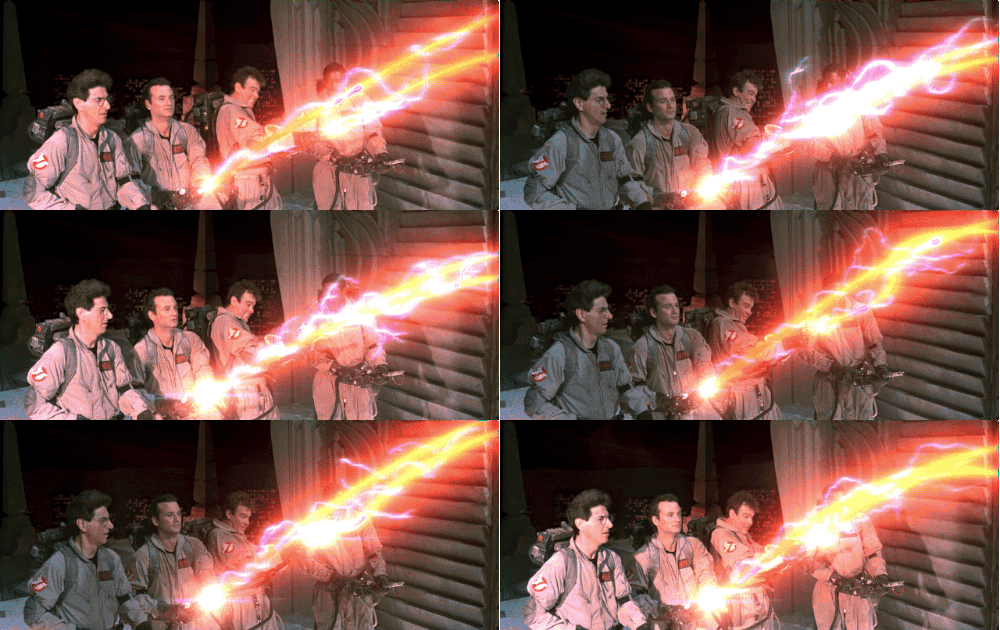
Ever see a group of people on the street just looking up? Makes you want to look in that same direction too, and it makes whatever they’re looking at that much more important.
That’s the power our attention wields.
The focus of our attention becomes inherently important.
Great marketers and directors (and unfortunately politicians) use this to misdirect us. They find ways to bring our attention to the thing they want us to focus on. And the more attention is brought to that topic or object, the more important it seems.
We underuse that power.
We misuse that power.
We abuse that power.
We give our attention to things and people that don’t deserve it, and ignore the things and people that do.
As a new parent and freelancer, I’m constantly trying to give my full attention to my daughter and my full attention to my work, but often unsuccessfully. Partial attention to both at the same time doesn’t do my work any favors, and is not making me a better parent.
Even if you’re not a parent, this shows up in other ways. Ads, notifications, bright lights or movement. And it pulls our attention towards the things that don’t matter, but are shiny and momentarily interesting.
We all have a limited attention span– a maximum capacity of focus and attention each day that runs out quicker the more we multitask and spread our attention thinner (Read about “Attention Residue” here, coined by Professor Sophie Leroy).
The solution is to monotask.
To be conscious and present about where you spend your attention, one thing at a time.
If we start to recognize the power of our attention– how it can change a relationship, improve our work, give meaning and value– we can start being more selective to who and what we give our full, undivided attention to.
What might it look like to give your full undivided attention to someone, even for just 10 minutes?
Keep Going
“You do not have to be good” — an analysis of Mary Oliver’s poetry by Austin Kleon
“To Control Your Life, Control What You Pay Attention To” by Maura Thomas, Harvard Business Review
Caveday is a company aimed at improving your relationship to work. We write regular posts on Medium and send out monthly Newsletters with productivity tips, life hacks, and recommendations. Sign up for the mailing list here.
Or sign up for Jake Kahana’s personal emails, called “The Email Refrigerator” here.